This website introduces the novels and writing of Derek Bates and include historical and romantic fiction and centre on human relationships. He has wide ranging interests covering social issues, politics, capitalism, economics, climate, psychology, business, technology, the future and art. He has lectured and written many articles on these interests. He also writes children's stories which, linked with his novels, are on YouTube as 'Manta has Gone'. He is currently working another novel, and a book of short stories.
Faith Leubner - Artist - A novel by Derek Bates
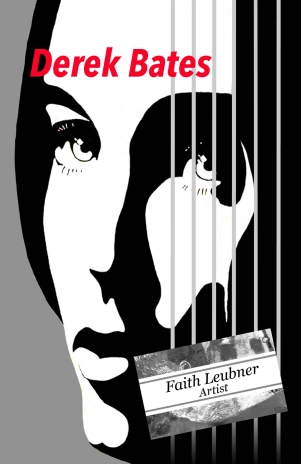
'Faith Leubner - Artist'. Haig Skarn, lecturer, meets Faith Leubner, struggling artist who feels as he does that the Western world is in disarray. Faith's controlling parents have died and left her affluent and, for the first time, free to make her own life. Intoxicated with her new freedom, she over- indulged her appetites and surrounded herself with facile people, and become bored. In contrast, she is attracted to Haig's working class background and his revolutionary ideas.
Faith helps Haig crystallise his ideas and raise funds to enable him to establish a political movement. She is able to introduce him to influential people and one, Sir John Hayweld wants to make his name as an innovative political motivator.
Haig and Faith marry when she becomes pregnant. She had always suffered periods of anxiety and, when her son is born, suffers post-natal depression. While Haig's life progresses, hers declines as she becomes fearful of the vehemence she sees being aroused by Haig's public speeches and writings. She cannot cope with the reactions of vested interest groups who see Haig as a threat to their comfortable lives.
Convinced that she has served her purpose, Faith's depression increasingly dominates and, after a mental collapse, becomes institutionalised.
While Faith is undergoing treatment Haig never ceases to love her and to believe that she will recover. He meets Bel Manners, whom he had known from childhood and has a platonic relationship with her. Bel, had married a successful businessman and, soon afterwards, wondered why, is lonely, and desperately in need of something to take over her life. She falls under the spell of Haig and his ideas for social change.
After the death of Faith, Haig, distraught, decides to cease political work realising that it has been partly responsible for the loss of Faith's sanity. In the final chapter he finds a letter from Faith, addressed to him, many years earlier in it Faith apologises for her emotional turmoil and asks that Haig continue with his work. Bel helps Haig with his political ideas and their relationship blossoms.
Published June 2025 by Reflective Productions LLP; ISBN 979-8289548320.
Agenda for the Future
'Agenda for the Future' effectively represents a political revolution. It is apparent that there is growing disillusionment with the ability of political regimes to manage economies throughout the world.
Recognising this, in 'Agenda for the Future', it is pointed out that a major defect in the way politics operates is that MPs and Ministers are untrained and thus experience difficulty in understanding the complexities of economics, disease, education etc. An example is Tony Blair, who, in his autobiography said, 'I walked in to No. 10 as Prime Minister. I had never had any job in government not even as the most junior of ministers.' He took UK into a war in Iraq which cost more than $1 trillion, resulted in over 100,000 deaths and produced no measurable benefit.
The book proposes that to advance Democracy, the population should be able to express opinions digitally and that Ministers should receive training and be selected by digital technology, giving the electorate an involvement in selection of MPs and an ability to contribute on important decisions such as HS2.
Agenda for the Future also deals with capitalism, artificial intelligence, business ethics, reform of taxation and other topics.
Published 2017 by Reflective Productions LLP; ISBN 978-0956004048.
Shadows in the Wall - A novel by Derek Bates
'Shadows in the Wall'. Using the transition of time and the inter-related story of love, the novel exposes the fallacy that politics and religion are for the good of the people. In a surrealistic atmosphere, the story interweaves the life of Sixteenth Century, Jacob D'Arcy. He is an Alchemist of remarkable intelligence, heir to a wool merchant business and married to Isabel. When Isabel dies of plague, Jacob takes in a housekeeper, a young ill-educated girl from the streets. He recognises that she has abilities and becomes a mentor to her.
In the 21st Century, Jake Dearsey, a journalist in his forties, buys Firenze House which had been built by Jacob D'Arcy. When Jake was in his late twenties he had been commissioned to write about Shakespeare and his influence on Freud's theories. Jake had visited Stratford on Avon and was introduced to Rhosa Cowen, a struggling 19 year old actress. With her mother, she had emigrated from Egypt as a ten year old and, because of her Egyptian accent was tormented at school. She finds recordings of Shakespeare's plays and recites them onto a tape recorder to improve her speech, and develops a love of Shakespeare's language and his understanding of the human condition. She and Jake have a brief affair but, because of a misunderstanding, they separate and both undergo unsuccessful marriages. Ten years on they meet again when Rhosa has become a successful actress and Jake's work is widely read. Their love re-ignites and they live together in Firenze House, platonically at first as a result of a traumatic experience Rhosa had with her ex-husband which rendered her frigid and she is constantly tormented that this will destroy the relationship with Jake.
In quiet moments their minds are separately invaded by illusions which they realise must be coming from the walls of Firenze House. Convinced that Jacob D'Arcy, Jake develops an alternative to the political system we have inherited and exposes its inability to cope with the future problems of the 21st Century. He writes and lectures on a different system of government, proposing a bloodless political revolution opposing the existing so-called 'democracy' which allows the electorate only to put a cross on a piece of paper once every five years. Jake and Rhosa feel compelled to find out more about Jacob D'Arcy and the girl he took in, whom they learn was called Mistry. Together with a Tyndale bible which they find behind a loose panel in a bookcase they discover documents in Latin and get them translated by a friend, Armand Mistrand an academic but a social misfit. From Armand's translation of the letters, they find that Jacob D'Arcy had been involved with three Vatican Cardinals, appalled at the licentious behaviour of the Pope and wanting him poisoned.
In trying to learn more about Jacob D'Arcy, Jake is introduced to Daniel Freidan, a charlatan and dilettante historian who claims exclusive knowledge of D'Arcy. Freidan is wearing a ring which Jake recalls he had seen on the finger in a painting of a Cardinal Valenti in a gallery. Armand's translations reveal that Valenti was one of the three Cardinals involved in the poisoning plot. Jake becomes jealous of Rhosa's relationship with a film director who invites her to make a film with him in Los Angeles, she and Jake separate. The pressures of success cause Rhosa to suffer a breakdown, fuelled by alcohol. She returns to Jake and relinquishes her career as an actress to devote her time to Jake's political reform projects.
Published September 2012 by Reflective Productions LLP; ISBN 978-0-9560040-1-7.
2nd Edition published January 2015; ISBN 978-0-9560040-2-4
Dance in an Empty Room - A novel by Derek Bates
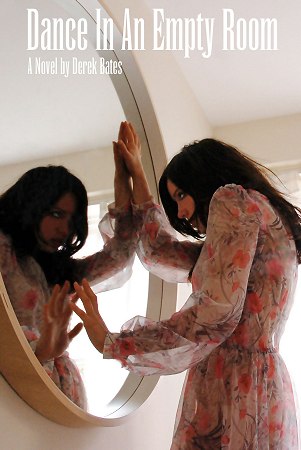
'Dance in an Empty Room' tells the story of Grace, a young woman, the daughter of a priest who wants her to be devoted to religion. She, on the contrary, wants freedom to live the life she chooses. She discovers the liberating dancing of Isadora Duncan and practises in the library of her home. Her father finds her dancing, tells her she must never dance again.
Grace then dances alone in the surrounding countryside (video of this dance can be seen here). Nearby, she finds an old, deserted artist's house. Inside is a painting of an attractive young man. Grace realises that she must find him. She leaves home and, following clues, ends up in a small village in the South of France where she finds the artist and his son Edward, the young man in the painting. But Edward is not as Grace expects.
Published January 2009 by Reflective Productions LLP; ISBN 978-0-9560040-0-0.



 'Faith Leubner - Artist'. Haig Skarn, lecturer, meets Faith Leubner, struggling artist who feels as he does that the Western world is in disarray. Faith's controlling parents have died and left her affluent and, for the first time, free to make her own life. Intoxicated with her new freedom, she over- indulged her appetites and surrounded herself with facile people, and become bored. In contrast, she is attracted to Haig's working class background and his revolutionary ideas.
 'Agenda for the Future' effectively represents a political revolution. It is apparent that there is growing disillusionment with the ability of political regimes to manage economies throughout the world.
  'Shadows in the Wall'. Using the transition of time and the inter-related story of love, the novel exposes the fallacy that politics and religion are for the good of the people. In a surrealistic atmosphere, the story interweaves the life of Sixteenth Century, Jacob D'Arcy. He is an Alchemist of remarkable intelligence, heir to a wool merchant business and married to Isabel. When Isabel dies of plague, Jacob takes in a housekeeper, a young ill-educated girl from the streets. He recognises that she has abilities and becomes a mentor to her.
 'Dance in an Empty Room' tells the story of Grace, a young woman, the daughter of a priest who wants her to be devoted to religion. She, on the contrary, wants freedom to live the life she chooses. She discovers the liberating dancing of Isadora Duncan and practises in the library of her home. Her father finds her dancing, tells her she must never dance again.